What a milkshake taught me about hunger
On expectation, belief, and how we experience food
Have you ever had one of those days where you’re doing everything ‘right’ with food and yet you’re still not satisfied?
- You choose the fat-free yoghurt because it’s lighter.
- You grab the low-calorie chocolate bar because it’s more sensible.
- You snack on the alternatives, the skinny versions, the things that are supposed to hit the spot without ‘overdoing it’.
And somehow, food is still on your mind.
Or maybe it’s this:
You’re craving a cookie. But you negotiate with yourself. You try the carb-free one. Then the 50-calorie one. Then something else that’s meant to be close enough.
By the end, you’ve eaten seven things and still don’t feel satisfied.
Whereas one actual cookie might have done the job.
Most people experience this and assume it says something about them.
About willpower. About discipline. About hunger cues being unreliable or broken.
There’s a study that suggests something else might be going on.
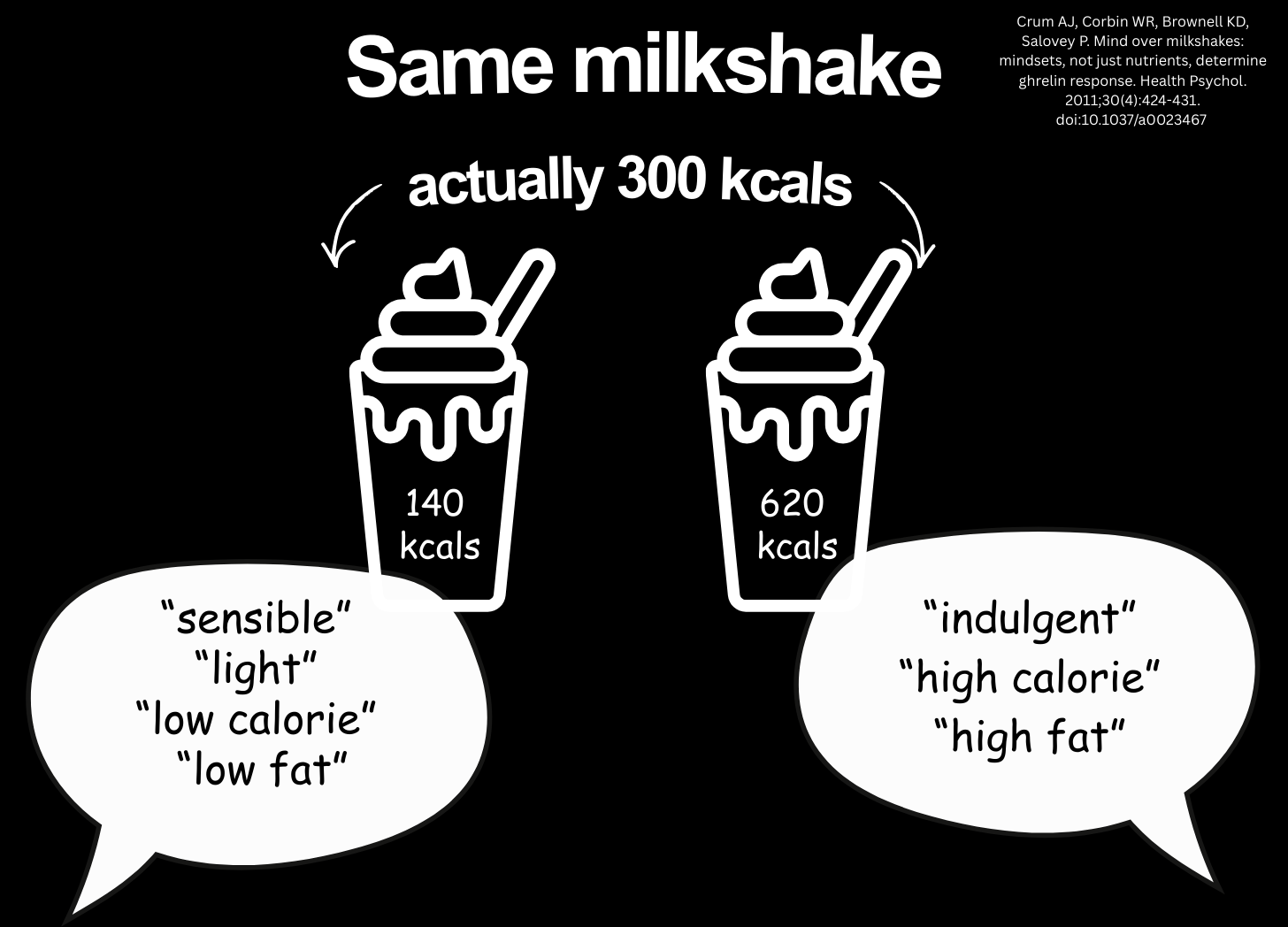
It’s a study I’ve been weirdly fascinated by for years.
It’s often called the Milkshake Experimentand was conducted byAlia Crum and colleagues at YaleUniversity.
Participants came into a lab on two different days.
Two morning sessions, one week apart. Each session lasted around 2.5 hours and took place after anovernight fast. Same time of day. Same conditions.
They were told something very simple:
That researchers were developing two different milkshakes with different nutritional profiles, andthat the aim was to compare taste, and see how the body responded to different nutrients.
On one visit, the milkshake was presented as ‘indulgent, high in fat, at 620 calories’.
On theother, the milkshake was presented as ‘sensible, low in fat, at 140 calories’.
Participants were asked to 1) look at, and 2) rate the labels before drinking the shake. Then theydrank it, while researchers tracked the body’s response through blood samples.
What they weren’t told was …
that the milkshakes were actually identical.
Same drink. Same ingredients. Same macronutrients. Same calories. Same everything.
The only thing that changed was the label.
What changed in the body
The primary hormone of interest was ghrelin.
Ghrelin is involved in appetite regulation. It tends to rise when we are hungry and fall after eating, helping signal that the body has been fed.
Here’s the interesting part.
When participants drank the milkshake labelled as indulgent, ghrelin levels dropped more sharply (increased satiety response).
When they drank the same milkshake labelled as sensible, ghrelin dropped much less (reduced satiety response).
Same milkshake.
Different hormonal response.
Placebo effect?
Kind of.
This isn’t entirely new territory. We’ve known about the placebo effect for a long time. The idea that belief and expectation can shape physiological responses is well established in medicine.
Expectation influenced appetite hormones that were measured objectively, under controlled conditions, with identical food.
It wasn’t just that people felt more satisfied. Their bodies responded differently at a hormonal level, based on what they believed they were consuming.
Why this matters outside a lab
Most of us don’t eat in labs. We eat in an environment saturated with labels and messages.
Low-calorie.
Light.
Reduced.
Skinny.
Only 70 calories.
These labels aren’t inherently problematic. Many of these foods are useful, convenient, enjoyable (?). But they carry an implied message: don’t expect too much from this.
And expectation matters.
The Milkshake Experiment shows that the body doesn’t just respond to what you eat. It responds to what you believe you’re eating.
The brain is not a passive observer of digestion. It’s actively involved in shaping how hunger and satiety are experienced.
And if the brain anticipates scarcity or restraint, it makes sense that the body would remain more alert to hunger signals.
Language shapes experience more than we realise
I believe the same thing happens in the way we talk to ourselves.
I’m on a diet
I’m restricting
I can’t have this
I have to cut out potatoes
All of that sets up an expectation of lack. Even before the first bite, the tone is one of deprivation.
Compare that with:
I’m adding more veggies, protein, ..
I’m nourishing my body.
I’m building a meal
I’m fuelling
Let’s be real, “I’m restricting” creates a very different internal environment than “I’m nourishing”.
Just to be clear
This isn’t an argument for having indulgent milkshakes every day.
This research doesn’t mean you can ‘think your way out’ of biology entirely. Calories matter. Fat slows gastric emptying. Energy intake influences satiety signals. Blood sugar responses differ depending on what and how much you eat. These mechanisms are well established, and they matter.
The Milkshake Experiment isn’t denying any of that.
What it does show is that biology doesn’t operate in isolation.
It’s not biology versus psychology. It’s biology with psychology.
Two foods can be identical on paper and still be experienced differently in the body depending on what the brain expects to happen.
Expectation shapes how hunger is felt, how satisfaction registers, and whether eating feels complete or slightly unfinished.
Seen through this lens, it becomes easier to understand why eating can feel harder when everything is framed through restriction, and why the same food can feel more or less satisfying depending on the story attached to it.
A final thought
I think just sharing this study already delivers the main message.
There isn’t a rule here. No ‘therefore you should’.
It’s more an invitation to notice.
To notice how much expectation shapes eating.
To notice how often that expectation is influenced by language, labels, and the food marketing landscape.
The stories around food shape how we experience it. And the same is true for the stories we tell ourselves.
Expectation is part of the meal. :)
xo
Zara