how to stop falling back into old eating habits
on the maths of changing your eating behaviour

You know what to do.
You’ve read the articles. You’ve saved the recipes. You know more about nutrition, health and fitness than most people.
You sat down on Sunday, felt motivated, and mapped out the week. Maybe you even got Claude to write you a plan and asked for something realistic, balanced and built around your actual schedule.
at first, you were into it. You remembered the breakfast. You prepped the lunch. You did the food shop. You were paying attention.
Then slowly, you weren’t
One morning you forgot. One afternoon got busy. You meant to prep something but didn’t. You got home later than expected and defaulted to what you normally eat. A stressful day happened and the new plan simply wasn’t the thing your brain reached for.
You just… drifted back. A week later you’re realising you’re mostly eating the way you were before.
So if you still ended up back in the same eating patterns, surely the problem is you?
You must be weak, inconsistent, undisciplined, bad at sticking to things, have no willpower
right?
Except there’s another explanation that makes a lot more sense ⤵
We keep treating this experience as evidence that something’s wrong with us.
But could the actual issue be that we’re trying to solve a repetition problem with more information?
insight does not instantly erase rehearsal.
You can know exactly what to do, how to do it, and why you keep doing the old thing, and still find yourself doing it anyway.
yes, we need to understand what’s driving the behaviour. We need to make sure the new habit is realistic, strategic and actually solves the problem.
But once the plan makes sense, and you have enough information and planning in place, there comes a point where there’s nothing left to optimise on paper. That’s exactly when the less glamorous part begins:
You have to practise the thing
At some point, nutrition advice has to turn into behaviour change.
Because knowing that you’d feel better if you went for a walk instead of collapsing onto the sofa with crisps and the TV the second you got home doesn’t mean you’ll suddenly do it.
Having five high-protein dinner ideas saved on Instagram is unfortunately not the same as making dinner.
At some point, the information has done its job. Now the behaviour needs practice.
And practice is where you’re likely to meet resistance.
Why disruption pulls us back to old habits
You’re literally asking your brain to repeat a behaviour that hasn’t yet become automatic while also juggling work, family, social plans, stress, poor sleep and everything else competing for your attention.
it’s no surprise that it feels mentally demanding.
The new behaviour still needs to be remembered, chosen and carried out on purpose. The old one does not; it already knows the route.
When life is calm, you have more spare attention to override the default. When life gets noisy, the brain becomes more economical. It reaches for what is familiar, well-rehearsed and easy to execute. Not necessarily what serves you best, just what requires the least thinking
So expect some resistance.
Expect to forget. Expect to need reminders.
Expect the new habit to disappear from your mind the moment work gets busy, you sleep badly, or the day becomes even slightly inconvenient. Your brain will keep pulling you back towards the default because the default is what it knows best.
When the new behaviour feels like effort and the old one feels like nothing, that’s not a flaw in you. That’s the system working exactly as designed.
Which also means resistance isn’t the enemy. It’s information. It’s telling you, quite precisely, how deep the old groove runs.
you have to plan for it
Plan for the disrupted day, not just the perfect one. Decide what the smallest version of the habit looks like when you’re tired, busy or off-routine, because those are the moments that reveal whether the behaviour can survive real life.
And when the resistance shows up, learn to notice it before immediately acting on it or turning it into a judgement about yourself.
The goal is not to perform the full plan every time. Sometimes it is simply to protect the repetition and keep the new pattern alive.
Because a habit that only works when you are highly motivated is not yet a habit. It’s a good intention being temporarily carried by enthusiasm.
You’ve heard this bit before
You’ve probably heard the usual language around neuroplasticity and habit formation, how repeated behaviours strengthen certain patterns in the brain and make them easier to repeat over time.
All true.
But there’s one metaphor that sticks in my brain much more than any of that ⤵
The thousand people on the rope
Imagine a tug of war.
On one side of the rope are 1000 people. They represent every time you’ve done something the old way. Years of repetition.
On the other side, there’s just 1, representing the new behaviour you’re trying to build.
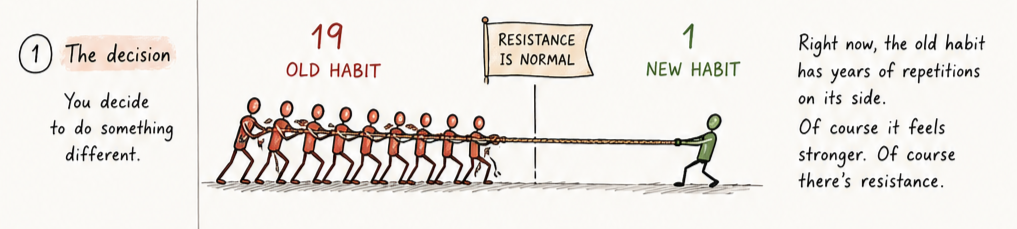
Of course the first attempt feels difficult. You’re one person pulling against a thousand.
Now imagine there’s one rule to the game: Every time you repeat the new behaviour, one person leaves the old side and joins yours.
One repetition = one teammate
So you do it again.
Now it’s 999 against 2
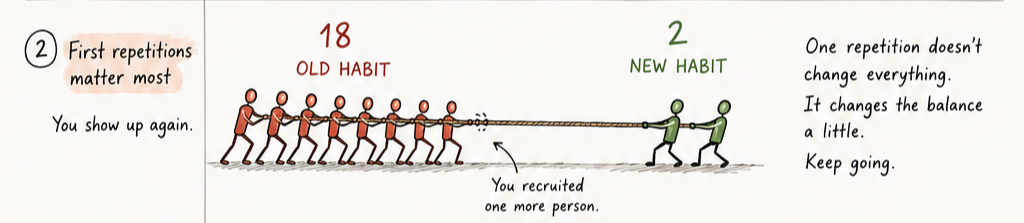
For quite a while, the rope barely moves.
That doesn’t mean nothing is changing. It simply means you’re still outnumbered.
This is probably the most frustrating part of changing a habit.
You can be doing everything right and still feel almost exactly the same. The old behaviour still feels easier. You still have to think about the new one. You still slip back sometimes.
But the balance is changing. You’re just not far enough along yet for the difference to be obvious.
The changes are happening below the threshold of perception before they become visible in behaviour
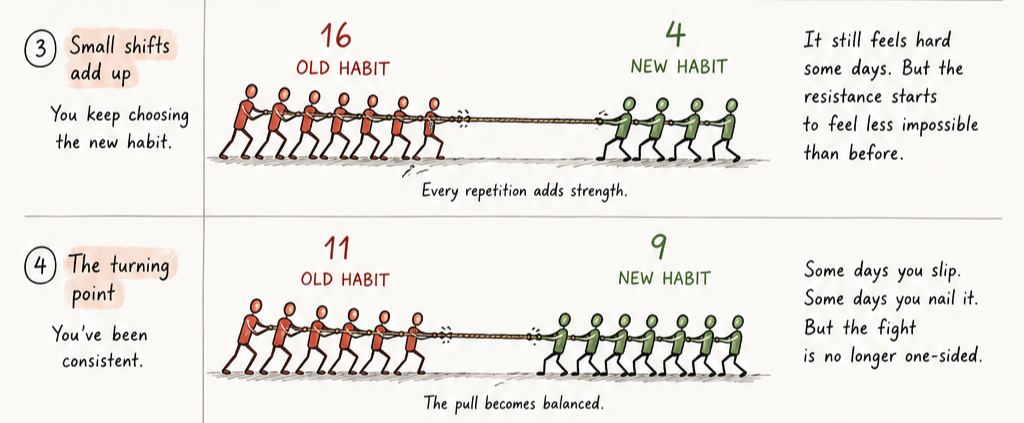
And then something interesting happens
Keep repeating the behaviour and eventually the two sides become much more evenly matched.
The new habit starts requiring less effort. You remember it more easily. You don’t have to argue with yourself quite as much.
Eventually, the equation changes
the balance tips.
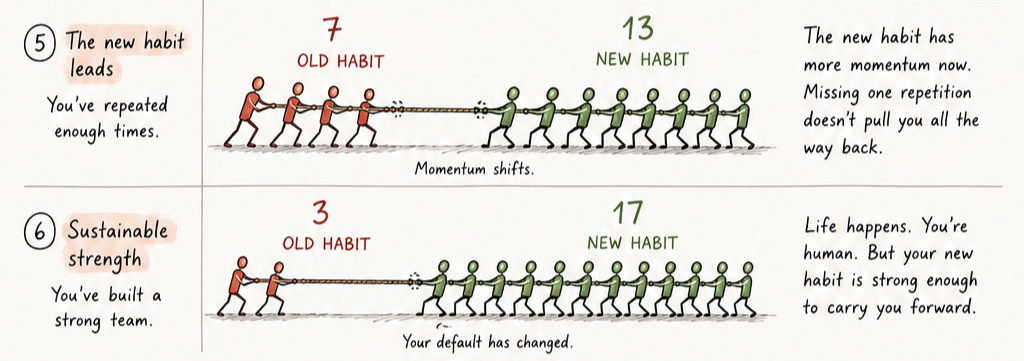
Once you’ve accumulated enough repetitions, the new habit starts doing some of the work for you.
Missing a few workouts, home-cooked meals or walks no longer unravels everything because the team you’ve been building is strong enough to absorb it.
That is the goal
Not to rely on accountability forever, but to rely on it long enough for the behaviour to become something your brain expects rather than something it has to be convinced to do.
Eventually, the thing that once required quite a lot of effort becomes almost boringly normal.
Consistency is less sexy than novelty
The goal isn’t to create the most impressive plan
It’s to create the plan that is most likely to be repeated. Because repetition, not intensity, is what gradually shifts the balance.
One thing I find reassuring is that science doesn’t expect habits to form overnight either.
One of the most widely cited studies on habit formation found that, on average, a new behaviour took around 66 days to become automatic. But the range was enormous, from 18 to 254 days, depending on the person, the behaviour, and their circumstances.
So if something still feels effortful after a few weeks, that does not automatically mean it is not working. It may simply mean it still needs more repetitions.
Here's the unglamorous part
Repetition rarely feels very exciting
It gives you far less of a dopamine hit than starting a brand-new diet on Monday, buying a new meal plan, or discovering some completely new way of eating that briefly makes everything feel fresh again.
We sometimes confuse that feeling with progress. We crave the energy of a fresh start and underestimate the value of doing the same useful thing again when it no longer feels exciting.
Novelty can make change feel easier to begin. But it does not necessarily make it more likely to last.
This could be an entire book
There are, of course, plenty of ways to make those repetitions easier: reducing friction, changing your environment, attaching the new behaviour to an existing routine, making the habit smaller, designing it around the life you actually have, …
I’m not going to unpack all of them here, partly because that would turn this article into a book, and partly because that book has already been written.
Atomic Habits by James Clear1 is the one I recommend repeatedly. It explains, with far more room than I have here, how small changes to your environment and systems can make good habits easier to repeat and unhelpful ones harder to fall into.
For now, the point is simpler:
the easier/smaller + more enjoyable/rewarding a behaviour is to repeat, the more chances you give it to become automatic.
This is why coaching can be particularly valuable in the early stages of behaviour change.
The beginning is where every repetition carries the most weight. Before the new habit has momentum, it’s competing against years of automatic behaviour.
Life gets busy. You forget. Work gets stressful. Old routines are simply easier to fall back on.
A coach can’t build the habit for you. They can, however, help protect those early repetitions. They provide structure, accountability, problem-solving and support at the exact point where the new pathway is still fragile.
Accountability reduces the number of decisions you have to make alone.
Structure removes unnecessary friction.
Regular support helps you navigate setbacks before they become abandoned habits.
And sometimes, simply having someone remind you that resistance is a normal part of the process is enough to help you keep going.
What I hope you remember
One of the biggest misconceptions about healthy habits is the belief that making a decision should make the behaviour easy.
It doesn’t.
The moment you decide to do something differently, you are asking your brain to override pathways it has strengthened through hundreds or even thousands of repetitions. Those pathways exist because the brain is designed to automate behaviour.
Automation is efficient. It conserves energy. Whether the habit is going for a walk after dinner or reaching for chocolate when you’re stressed, the brain doesn’t initially distinguish between what is healthy and what is harmful.
It simply favours what is familiar.
This is why resistance is such a normal part of behaviour change.
It’s not a sign that you lack motivation, discipline or willpower. It is the predictable experience of asking your brain to take a route it has travelled far less often.
The old behaviour feels effortless because it has become automatic. The new one feels uncomfortable because it still requires conscious effort.
Understanding this leaves room for self-compassion, but it also leaves room for better strategy. You stop asking, What is wrong with me? and start asking
What is making this so difficult to repeat?
Every time you repeat the new behaviour, however, you strengthen that pathway a little more. Eventually, what once required determination becomes the easier, more automatic choice.
The goal, then, isn’t to rely on willpower. It’s to repeat the smallest version of the behaviour enough times that your brain no longer experiences it as new.
Chances are, this article is simply more information arriving on top of all the nutrition information you already have.
slightly awkward ending for a piece arguing that information is rarely the missing part
But perhaps it’s the kind of information that changes what you do with the rest of it.
Perhaps, the next time resistance appears, you will recognise it for what it is, recruit one more person to your side, then do it again tomorrow, and let the arithmetic do what arithmetic does.
Right, enough reading. One tiny repetition, please and thank you
xo
Zara
🫶 When you’re ready, here’s how I can help:
I’m a Registered Associate Nutritionist and health coach, and I’ve worked with hundreds of people throughout my career to make realistic, long-term changes to the way they eat through coaching, accountability and ongoing support.
If you’d like help doing the same, you can book a call with me here: book a call