optimisation culture has a resilience problem
on wine, whoop scores, and the moment optimisation becomes fragility
Steven Bartlett went viral recently for saying that a few glasses of wine ‘ruined three days’ of his life. 1
In his own words: ‘I got worse sleep that night, and then because I got worse sleep that night, I ate more poorly the next day because my dopamine system or whatever, the cortisol system was all messed up. I podcasted worse. I didn't go to the gym that day or the day after because I felt really bad. I then slept worse. These three glasses of wine had this hidden domino effect that I must've been living with my whole life’
Bartlett tracked these negative impacts using his Whoop, which clearly recorded the changes to his sleep, recovery and biomarkers.
The internet split - half the comments were mockery, the other half were nodding along
But I think most people missed what this clip was actually about
Because this isn't really a story about wine, or sleep scores, or even Steven Bartlett. It's a story about optimisation culture - what it promises, what it costs, and what it does to you when you've been inside it long enough
a few clarifications before we dive in
This piece isn’t aimed at people whose goals require precision - athletes, bodybuilders, performers, anyone working towards a specific outcome where tracking has a clear purpose, context and endpoint
it is aimed at everyday health - those who are trying to feel well, live well, and look after themselves, but have somehow inherited the mindset of elite optimisation
This post isn’t really about wine. Alcohol does affect sleep, recovery, appetite, mood, training, decision-making and how someone feels the next day. That’s not a point I’m trying to dispute. The interesting part isn’t that a few glasses of wine had an effect - it’s the story that came after, and the way one imperfect input created a domino effect that lasted days
This isn't a post to have a go at Bartlett as a person either - his reaction makes sense inside the world he operates in - high performance, tracking, marginal gains, systems, metrics, recovery scores, better sleep, better focus, better output
(and if we're honest, most of us will recognise some version of it in ourselves)
I find the clip interesting because it feels like a useful doorway into a much bigger conversation about high-performance optimisation culture - that is the conversation I want to have.
If your entire system is so tightly engineered that the smallest flexibility derails you for three days …
at what point do we stop calling that optimisation and start calling it fragility?
You can build the most optimised routine in the world but life is still going to be life. So the question becomes:
have you built a system that can absorb that?
or have you built one that collapses the second things become slightly disrupted?
There’s a curve in optimisation that nobody talks about
The early gains from improving sleep, nutrition, and movement are dramatic and real.
But at a certain point - once the foundations are established - the marginal gains from further optimisation become vanishingly small, while the psychological cost of maintaining the system keeps rising
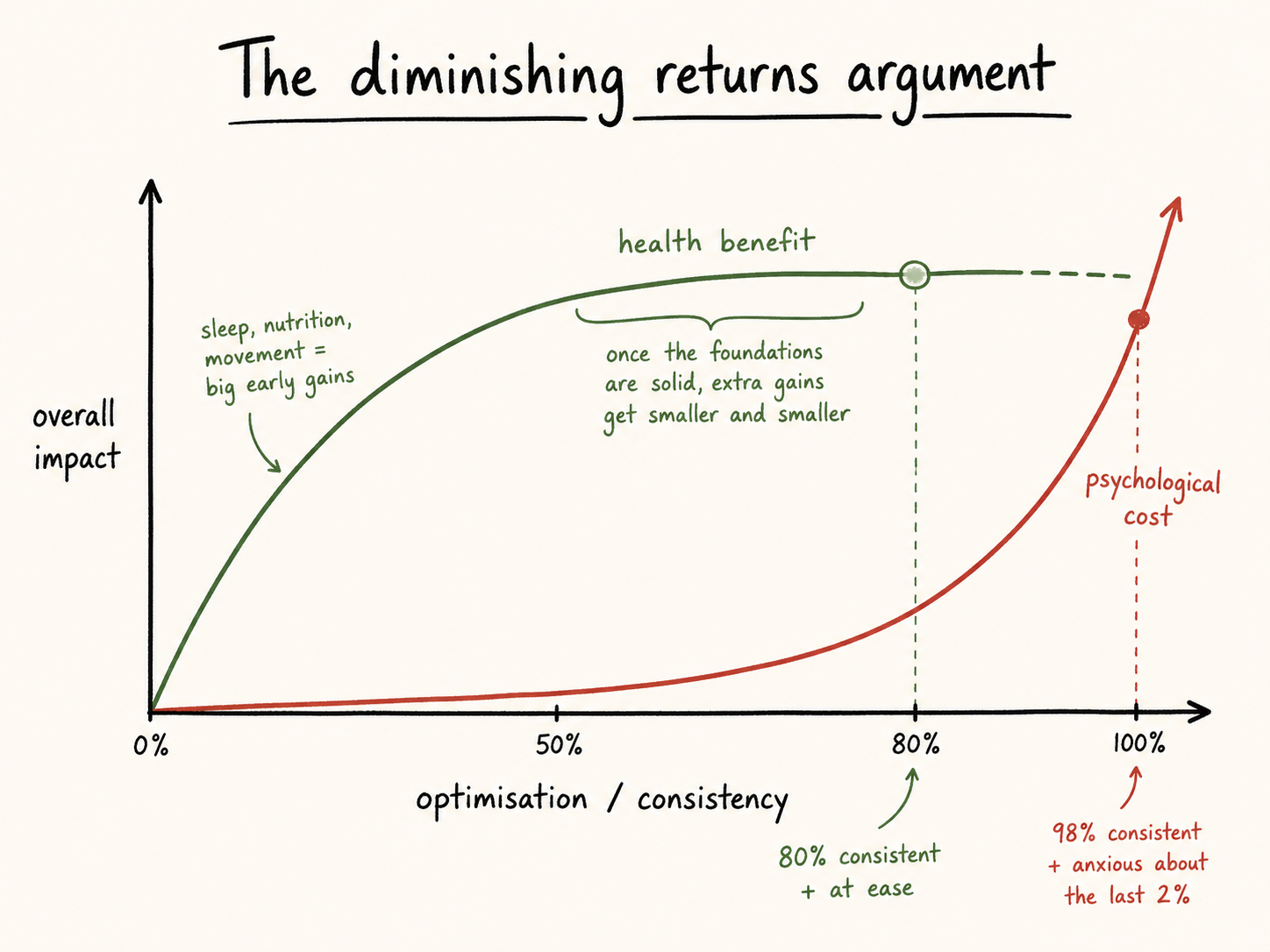
Most people would get far more health benefits from being 80% consistent and psychologically at ease than from being 98% consistent and anxious about the 2%
Here’s the thing : the more optimised everything becomes, the less resilience the system actually has. Because optimisation becomes brittle when it has no margin.
When the plan depends on perfect sleep, perfect food, perfect timing, perfect motivation, perfect emotional regulation, perfect routine, perfect self-control, perfect life logistics.
So if one small disruption creates a domino effect that lasts for days, the question is not only ‘how do I avoid that disruption?’
it’s also:
why are the dominos so close together?
why is there so little buffer?
why does one imperfect input create such a strong sense of collapse?
why does the system have no shock absorption?
Because that, to me, is the real work of balance - spacing the dominos out. building margin. building flexibility.
Building a life where one imperfect choice can have an effect without becoming a catastrophe
The domino effect didn't start with the wine
Most people set their health goal at ten.
Ten = the ideal week.
The perfect routine. All sessions hit. Meals structured. Sleep protected. Steps done. Everything tidy, disciplined, and on track.
Then life happens.
A late night. A stressful week. A work trip. A dinner that goes long. A glass of wine that turns into three. The gym session that gets missed. Normal, unremarkable human life.
And instead of ten, they land on eight.
But when the only acceptable outcome is ten, anything less doesn't register as a slightly imperfect week - it registers as being off track. So eight gets filed under failure.
and once eight is interpreted as failure, the system has already tipped into all-or-nothing thinking
If I have failed the plan, I may as well keep failing.
If I am off track, I may as well stay off track.
If today is already ruined, then tomorrow can become the fresh start.
The behaviour itself was small. The meaning attached to it becomes enormous.
And that is the fragility built into a ten-only plan - it’s one stressful week, one disrupted routine, one late night, one emotional wobble away from collapse at any point.
This is what psychologists call the ‘what-the-hell effect’
the tendency to turn one deviation into permission to abandon the whole plan
And that feeling - not the wine, not the missed workout, not the late night - is often what actually derails everything.
The body may have absorbed the disruption perfectly well, but the mind has already turned it into a narrative.
You are no longer simply returning from a normal human variation. You are recovering from a story you have told yourself about what that variation means.
That you are off track. That you’ve failed. That you have lost control. That the week is ruined. That you may as well start again Monday. That the version of you who had everything together has disappeared, and now you need to claw your way back.
This is where the domino effect really begins
the gap between what the body actually experiences and what the mind makes of it is, I'd argue, one of the most underexamined variables in the entire health conversation.
We talk endlessly about inputs - sleep, nutrition, training, recovery. We talk very little about the story that runs alongside all of it -
the internal narrative that decides, before the body has even had a chance to respond, whether this was a slip or a disaster.
The spiral that Bartlett described may have started with the wine. But what sustained it for three days was almost certainly something else entirely.
Most people are trying to be healthy inside a system that only gives them two options:
on track or off track
Most people do not quit because they did nothing. They quit because they did something, but it did not match the ideal they had in mind.
They trained three times instead of four. They cooked four decent meals but ordered food twice. They slept well most nights but had one late one. They ate normally all week and then had a messy dinner on Saturday. On paper, that is still a fairly healthy week. In real life, it might be 80% of the plan.
But if the plan only recognises 100%, then 80% gets filed under failure.
That is how perfection-based plans distort reality. They train you to measure yourself against what was missing, rather than what was maintained.
Here’s what changes the pattern
You stop building the plan around one acceptable outcome, and you build it around a range :
8, 9, 10 - they all count
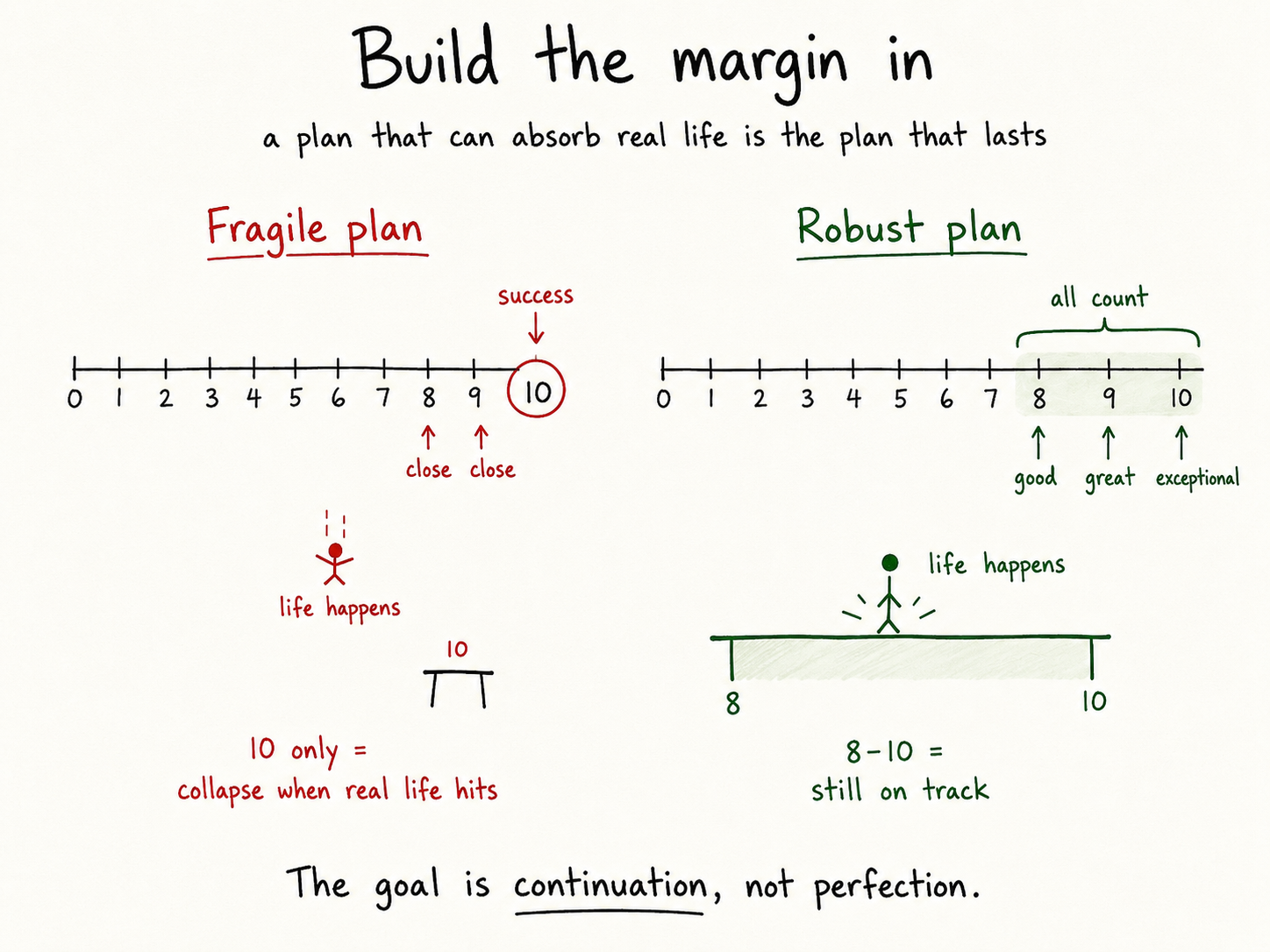
A range gives you more options, and that matters because less than perfect is still something.
You can miss the gym once and still go for the walk. You can order the takeaway and still swap the chips for a side salad. You can have a late night and still have a balanced breakfast the next morning. You can have a chaotic week and still keep enough of the foundations in place.
A range creates nuance
It’s the space between all in and all out. The place where you’re not doing the perfect version, but you’re still doing a version.
You’re still making an effort. You are still choosing care where you can. You are still in the system, even if the system looks less polished than usual.
This is the part people often misunderstand
They think building margin into a health plan is lowering the bar.
It’s not. It’s understanding reality. Because a plan with zero tolerance for deviation will still be deviated from; it just has no answer for when it happens.
The plan that lasts is rarely the one that demands ten every day. It is the one that understands eight still counts, nine is brilliant, ten is lovely when it happens.
The comeback matters more than the slip. And the fastest comeback is the one where you never really framed it as a slip in the first place.
consistency isn’t built by pretending life will never interrupt you. It is built by designing a system where interruption has already been accounted for.
Self-knowledge and self-tracking are not the same thing
We are living in the golden age of self-tracking.
Track your sleep. Track your steps. Track your calories. Track your cycle. Track your glucose. Track your heart rate. Track your mood. Track your habits. Track your macros. Track your screen time. Track your deep work. Track your recovery.
Track your entire human existence until you have enough data to feel like you are finally in control of being alive.
And to be clear, I am not anti-tracker. In the right context, with the right intention, self-tracking can be useful. If I wanted to look at a specific parameter, I’d absolutely use one.
But there are two very different versions of what tracking can become.
there’s a version that expands your relationship with your own body - that makes you more attuned, more trusting, more capable of reading your own signals accurately and making good decisions in real time.
and there’s a version that gradually transfers authority from your own experience to a device on your wrist, until you’re not even sure how you feel until you’ve checked your score
once the number becomes the authority, your own internal experience becomes secondary evidence.
and the more you rely on data to tell you how you are doing, the easier it becomes to lose confidence in your own ability to know.
it’s completely possible to have endless information about your body while also having less actual connection to it.
I haven’t worn a fitness tracker daily in over a year - no Fitbit, no Apple Watch. And honestly it’s been fine, more than fine. Weirdly enough I even feel like I know my body better for it.
What exactly are you optimising for?
and at what cost?
There was a period in my life where every metric looked exceptional. Resting heart rate, impressive. HRV, great. Diet, spotless. Training, never missed. I was, by every measure that mattered to me at the time, doing incredibly well.
I also had no period for months, my social life had shrunk, and I was exhausted in a way that no amount of ‘optimal’ sleep seemed to fix. I was living in a low-grade state of fear - fear of deviation, fear of the metrics dropping, fear of what would happen if I loosened the grip even slightly. Looking back, I was optimised to the point of barely functioning as a human being.
but hey my HRV was great ✌🏼
Impressive metrics and genuine wellness are not the same thing, and it’s entirely possible to achieve one while completely dismantling the other
Because if the goal of optimising your health is to live a fuller, richer, longer, more present life - and that’s what most people say it is - then a framework that turns an enjoyable evening into a three-day crisis is not getting you closer to that goal - it’s the opposite of that goal
You’ve successfully optimised yourself out of the very thing you were optimising for
Somewhere along the way, the route became disconnected from the destination. The process became the point. And the habits designed to support life began to compete with life.
The missing metric
What was the quality of that evening? What did those three glasses of wine accompany - what conversation, what laughter, what kind of ease?
If that dinner strengthened a relationship, provided fun and restoration through human connection - all of which have measurable downstream health effects - then the recovery score the next morning is not the full picture. It’s not even close to the full picture. We just don't have a wearable for it.
A wellness framework that has no room for joy is missing something fundamental
Because what is the purpose of all this, if not to live better? To have more energy for the people we love. To feel more present in our own lives. To be able to work, create, connect, rest, think, move, laugh, travel, eat, love and participate in the world with some degree of vitality. Longevity is only worth something if there's a life inside it worth living that long for.
The wine didn't ruin three days.
But a framework with no margin for being human might be costing a lot more than that.
And the Whoop, for all its sensors, will never be the one to tell you.
xo
Zara
Thanks for reading 💋 Enjoyed this? Send it to someone who would too